The case for switching to Heartbeat Time

Spring forward, fall back
As we move rapidly towards the end of October, an important seasonal calendar event approaches us with comforting certainty. No, I don’t mean Halloween, that perfect blend of processed sugar and devil worship that has emerged as one of the American Empire’s most beloved holidays. I’m referring to the other autumnal rite: the turning back of the clocks. The constant low-level grumbling about how unnecessary it is, has become almost as much a ritual as the time change itself.

Yet I confess I have never much cared about it either way. Do farmers need more light in the mornings for late planting? Does bumping peak traffic out of twilight more quickly reduce the amount of traffic accidents at dusk? My guess is that when all the variables are plugged into the cost-benefit equation, any effect either way will be more than drowned out by the hefty error term – meaning no one knows and it doesn’t much matter.

What’s in a base? A day by any other base would last as long
But allow me to hijack the discussion to propose something that, I believe, does matter: a simple and elegant means by which we can improve the quality of life of every human on earth. Society pays a small initial cost, and life gets better for everyone, until the end of time. Allow me to explain.

We all know that there is a reason why we have 365 days in a year (with an extra day added once every 4 years). The maths comes to us straight from God, who in His infinite wisdom decided the Earth should complete 365 axial rotations in the time it takes that celestial body to complete one orbit of the Sun.

But the Almighty set no such rules when it came to the division of a day into lesser units of time, and so man decided to create sub-units of the day as he saw fit. Different systems were tried, but the Egyptian solution survived, owing to its practicality: 24 is a good number to use because it has many factors (1, 2, 3, 4, 6, 8, 12, 24). Especially useful are the factors 2, 3 and 4 because they allow us to divide into halves, thirds and quarters respectively. This is something we often like to do. Ditto for 60. So on the face of it, 24 hours/day; 60 minutes/hour; 60 seconds/minute looks like a good, if entirely arbitrary, system. You might ask: If nature doesn’t demand otherwise, why on Earth would anyone want to change it?

Tick tick, boom boom boom
The problem is that this system does, in fact, clash with nature. Unfortunately, our current (mathematically convenient) temporal divisions are slightly out of sync with the most important clock nature has given us: our hearts. The average human heart rate at rest is about 80 beats per minute, just a little faster than the 60 seconds per minute set out by Greeks and medieval clockmakers.

The effect of this is subtle, yet I believe it can have far-reaching consequences. Our internal clocks are always struggling to calibrate to the artificial rhythm of the clock. It’s like we are trying to sing along to a song that is being played in slightly the wrong time. Counting seconds out loud is difficult as a result – and the point is it shouldn’t be. If clocks were synced to our bodies, counting seconds would come naturally to all of us. Indeed, the very act of doing so would have something meditative and relaxing to it. Time itself would become a form of mindfulness.

For most of human history, this asynchronicity was nothing to worry about. After all, most of us had no access to timepieces of any description: the only chronology that mattered was sunrise and sunset. But as more and more of us are now ‘on the clock’, I believe this problem of ‘horological asynchronicity’ has become a hidden and persistent form of stress. The only reason we are not more aware of it, is because it has been with us thousands of years.

It’s time to take time to heart
The solution has always been simple: simply change the division of time. A quick fix would be to rejig the divisions of time within a standard minute, so that there were 80 seconds a minute, rather than the current 60. I don’t think this is a good durable solution, because it simply kicks the can down the road: The asynchronicity still exists, but now it occurs through the misalignment of heart beats with minutes.

The solution is to rejig the entire arbitrary system, by creating a 32-hour clock.

A 16-hour analogue clock, marking half of a 32-hour ‘heartbeat day’

This is done easily by speeding up each second by 33.3%. If we keep base 60, faster seconds yield faster minutes. Whereas Ptolemy’s system gives us a 1,440 minute day, Heartbeat Time has a 1,920 minute day – with each of those minutes feeling like a natural duration of time in terms of heartbeats. The next step is to divide the minutes by 60, (so keeping our base). This yields 32 hours in the Heartbeat day.

If this be the hour when we draw swords together, let’s at least shorten the hour by 33%!
I feel like heartbeat time would have subtle advantages over current timekeeping – beyond the natural rhythm it respects. For example, for me, a standard time hour feels too long. And that’s because for most practical purposes, it is too long. Hour-long meetings drag and drag. Hour long lectures in college always contained about 40 useful minutes of information and sitting through the rest usually meant fighting the urge to take a nap.

And what about waiting for a bus that comes ‘every hour on the hour’? How is that at all useful to commuters? Never mind the joy of being able to tell children they will now get to stay up until to 12 O’Clock at night!

I’ll admit, the 32-hour heartbeat clock does lose us the ‘3’ as a factor – which is useful, for example, for factory shifts. But I think it would work out even better: my guess is having 3 11-hour shifts eliminates a lot of problems, because it allows for two 30 (heartbeat) minute overlap at the two crunch changeovers (morning and afternoon). And for anyone who’s done shift work, we all know that these handovers can cause a lot of friction.

The only problem is getting the entire world to reprogramme their software systems, replace their clocks, change their watches and so forth. No big deal.
Reclaiming science

As the debate heats up, I find myself getting more and more interested in the politics of climate science. What is interesting is how lost the concept of ‘science’ has become in today’s society. To see how, we need a little look at the history of science. As far as I can tell, ‘science’ has gone through three distinct stages.

There was a method in their madness

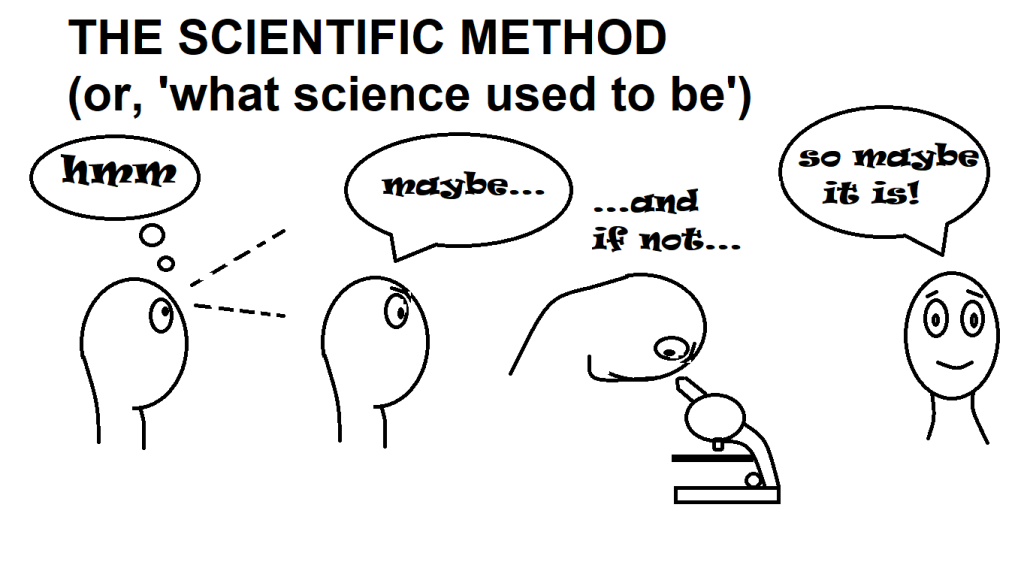
To begin with, ‘science’ was a method. It was a way of thinking about how to solve problems, by formulating ideas and testing those ideas empirically to see if they stood up to scrutiny. The method was quite simple: you start by looking at the world, observing things and making associations. You smell, taste, see and feel your way around this universe. As you do so, you notice associations and patterns. Some could be meaningful, some could be coincidence. It doesn’t matter, you are ignorant but curious. Most of all, you are humble.

Observation => Hypothesis => Critical scrutiny (testing) => Theory

Next, you look at the associations that seem to make the most sense. You then formulate a hypothesis based on what you observe. This is a guess about the relationship between things you observe in the universe – does one thing cause another? Is there a pattern here? Is it likely to happen again? It’s important that the hypothesis is falsifiable – i.e. that you can think of ways in which, if the hypothesis is untrue, you can show that it is untrue.

Next, you test your hypothesis. The goal of testing is to prove the hypothesis wrong. You think of as many ways as possible that the hypothesis might be shown to be wrong and you test all of these ways. Remember, you are humble. Your goal is to prove yourself wrong, to rule out a false association, not to have your name put up in lights.

If, however, the hypothesis survives lots and lots of rigorous testing, we get to call it a ‘theory’. The longer a theory survives consistent critical scrutiny, the stronger the theory becomes, scientifically speaking. We don’t call it ‘truth’, but we imagine that by continuously and selflessly applying this method, over and over again, we can begin to approach the truth.

In these early stages, scientific journals were a useful way for scientists to share their findings. The peer review process formalized the shared interest in scrutiny. As real scientists, we welcome this scrutiny, because remember – as humble scientists our goal is to rule out bad hypotheses. The more scrutiny, the more we rule out falsehood. It’s like a piece of iron, getting hammered on a hot anvil, again and again, until it turns slowly into hardened steel.

From the ‘fields’ to the ‘silos’

This method was applied with varying degrees of rigor to many fields of inquiry. And with success, came a new Steel Age of Enlightenment. Slowly, over time, some of those fields became synonymous with the method itself. The set of disciplines is amorphous, but is usually thought to include the ‘hard’ sciences like physics, chemistry, biology, as well as some applied sciences, like engineering and medicine, and then bleeds into the ‘social sciences’ like economics, politics, psychology and… ehem ….sociology.

As the number of disciplines claiming some connection to ‘science’ grew, the rigor with which the scientific method was applied grew more lax, giving rise to the dysphemism ‘pseudo-science’ to describe disciplines that wanted to enhance their legitimacy by claiming an association with the scientific method, without actually having to apply that method to their work. This is in part the cynicism of academia, but it is also a reflection of a key limitation of the scientific method: the requirement that hypotheses be falsifiable. Particularly in disciplines where laboratory experimentation is not possible, disproving a hypothesis is hard. In social sciences, all you really have is population level data. You can try to be rigorous using statistical sampling techniques, but as Frederick Hayek points out in the excellent rap battle against Keynes, “econometricians are ever so pious. Are they doing real science, or proving their bias?”

And as the scope of academia balloons out with the expanding university educated middle classes, the corpus of ‘scientific’ literature must grow, even beyond the confines of useful experimentation and hypothesizing. More and more, dodgy population-level datasets are being drawn upon to produce ‘scientific’ findings. The scientific journals, once a convenient place for scientists to expose their work, are now little more than tools for would-be professors to build their resumés. Now we are already at the point where real scientists should start getting worried.

Follow The Science, for His name is Fauci and He is your shepherd

But it gets worse. Because not only are bloated universities and dodgy pseudo-sciences creeping in on our humble method, but somewhere along the line, we enter the third and final stage of ‘Science’, in which all humility is about to get polluted by something much worse than a middle class 28 year old who dreads the idea of having to look for a real job: the sinister influence of Big Money.

That’s right, the real attack to science comes not so much from the patched-sleeved tweed jackets of the sociology departments, but from the lab-coated back door of the applied sciences, and in particular from medicine. As academia expands, the game becomes about funding – research grants, partnerships, what have you. At the same time, as Big Pharma grows to become one of the biggest industries in the West, a set of government institutions and research agencies grows entwined with the business interests of these for-profit companies. Soon, the academics are indistinguishable from the editors of peer-reviewed journals, and from the revolving door between the industry-funded regulators, the government-funded Institutions that dole out research funding, and the industry itself.

This set of institutions has now developed a stranglehold on the peer review process. They fund the research, thereby setting the agenda. They have even created standards for creating evidence – including things like double-blinded randomized control trials – which only they can afford to carry out. And when even those safeguards fail, they resort to the basest of tactics to suppress dissenting views. Remember, dissenting views are the very essence of what science used to be. Now we are treated to popular slogans like “I believe in Science”, pronounced by zealots who are too simpleminded or ignorant to appreciate the irony in that statement.

The climate around science needs to change

This is all regrettable, but not momentous in a world where this ‘science’ remains contained in the lecture halls and laboratories. But of course, it does not and cannot content itself with that.

It leaks out of the lab and into the very real world we are all forced to inhabit, bringing us things like lab-engineered viruses, and the whole host of harmful and ineffective responses to the problems this ‘science’ has created in the first place: social distancing, masks, lockdowns and novel, vaccine-like mRNA treatments.

But perhaps nowhere is the application of Institutional Science so dangerous as in the field of Climate Alarmism. The planet is in peril, don’t you know, and if we don’t Follow the Science, we’ll all burn.

But will we though? The first thing to note about Climate ‘Science’ is that it does not welcome any dissent or attempts to prove it wrong. Rather than being a steel theory, made harder by the pounding of many critics’ hammers, it is a fragile house of cards, built high and tall upon a tower of assumptions and modelled results. Any criticism is met with violent defence, like the overprotective mother of a sickly little child.

Those criticisms are many and obvious, so I’ll be brief in my enumeration: (1) lack of falsifiability i.e. what would it take to prove the climate theories wrong? Any temperature anomalies or changes are just retrofitted into the models and a new, even more dire, IPCC report comes out the next year. (2) model misspecification can anyone explain the relationship between the basic physics constants and the climate sensitivity parameters in the models? What about missing explainers like cloud albedo, photosynthesis, solar irradiance flux? (3) measurement error – what is the temperature anomaly, really? How well are we controlling for heat island effects? How well are we measuring solar irradiance, for that matter? (4) Model invalidity – what about all the things the models didn’t explain before, like ocean temperature anomalies? If we don’t understand them, how predictive are these models really?

What we need to do is stop, take a deep breath and go back to the scientific method. Let me attempt to do that now.

I spy with my little eye something beginning with ‘s’

The first point here is that it is not arrogant or unscientific for a ‘lay’ person like me to attempt to look at the issue scientifically. If you go back to the original definition of science, in fact it is the very essence of inquiry: simple observation.

So that’s where I start. The first thing I notice is that indeed, it has been getting hotter. I have lived in many place in the Northern Hemisphere and talked to many residents of those places and one can indeed observe pretty big increases in temperatures across the hemisphere.

When I look in the sky, the thing that I observe to be making it warm is the massive ball of energy in the sky, so my first hypothesis would be: is the sun getting ‘hotter’, i.e. emitting more energy than before? I don’t know, but let’s call that hypothesis number 1.

Next, I think about the rock I am standing on. It feels like cold earth at my feet, but I know from going into mines that actually, that cold earth gets pretty darn hot pretty quickly when you start to dig down. In fact, it seems that the earth’s average temperature is not 17 degrees the way we think, but rather it’s something closer to 4,000 degrees Celsius. This matters, of course, because all that heat is constantly radiating up through the mantle and onto the surface, then into the atmosphere and into space.

Much of that effect comes through the oceans, which are closer to the hot core. So my next question would be, is that process very, very constant? What if changes in the diffusion of heat through the mantle were warming/cooling the oceans at a different rate? I don’t know, but let’s call that hypothesis number 2.

Next, I look into the night sky above my Belgian home and see something remarkable in the northern sky. Dazzling colourful lights. Beautiful. But also kind of scary. What’s going on? I’m told it’s changes in the magnetosphere, and that the magnetic poles are in a ten-thousand-year process of ‘flipping’. Could such disruptions in the magnetosphere impact the penetration of certain rays from the sun? I don’t know, but let’s call that hypothesis number 3.

Then there’s the burning of carbon fuels by humans. Millions of gallons of oil every day, and in ever increasing quantities. All the fuel creates heat of course, but that first-order effect might be small. However, perhaps this creates some emissions that change the composition of the atmosphere. Also seems to be a small effect, but let’s see. After all, I don’t know. So let’s call that hypothesis number 4.

Others might have more and better ideas. That’s fine too.

Now let’s work through our hypotheses one by one, trying hard to disprove them. And let’s see which ones survive the best.

My hypothesis on that? Given what I know about the monster ‘science’ has become, the best survivor is unlikely to be the scientific method.